



⚡ Key Takeaways — TL;DR
- A safe charger carries third-party certifications (UL, CE, MFi), uses quality internal components, and includes multiple protection circuits.
- Counterfeit and unbranded chargers skip the safeguards that prevent overheating, fire, and device damage — the price difference is not worth the risk.
- The single fastest way to verify a charger is to look for the certification mark and cross-check the model number on the certifying body’s database.
Walk into any convenience store or scroll through a discount marketplace and you’ll find phone chargers for under two dollars. The question serious buyers — and safety-conscious professionals — always ask is: what actually separates a safe charger from a dangerous one? The answer lives inside the engineering, not the packaging.
In my professional experience reviewing consumer electronics and power accessories, the gap between a certified charger and a counterfeit one is not cosmetic. It comes down to internal architecture, certification rigor, and the presence — or absence — of protection circuits that sit between your device and a potential fire hazard.
This guide breaks down every variable that determines charger safety so you can make an informed decision the next time you buy.
Safe Charger Certifications: The Non-Negotiable Starting Point
Certifications are the first filter. A charger that hasn’t been independently tested by a recognized safety laboratory has never had its internal components or failure modes scrutinized by anyone outside the factory that made it.
Here are the certifications that actually matter:
- UL Listed (Underwriters Laboratories) — North American gold standard. A UL mark means the charger was tested to the UL 60950-1 or UL 62368-1 standard.
- CE Marking — Required for sale in the European Economic Area. Confirms compliance with EU electrical safety directives.
- Apple MFi — “Made for iPhone/iPad” certification means the accessory passed Apple’s electrical and compatibility testing protocol.
- FCC ID — Required in the US for devices that emit radio frequency energy. Its presence confirms regulatory submission, not just self-declaration.
- RoHS Compliance — Restricts hazardous substances in electrical equipment. Not a safety mark per se, but indicates manufacturer accountability.
- PSE (Japan), BIS (India), SAA (Australia) — Regional equivalents that confirm local regulatory compliance.
Warning: A printed logo is not the same as a real certification. Counterfeit chargers routinely print UL and CE logos without ever submitting a product for testing. Always verify the certification number on the certifying body’s public database.
What Makes a Charger Safe Internally: The Components That Count
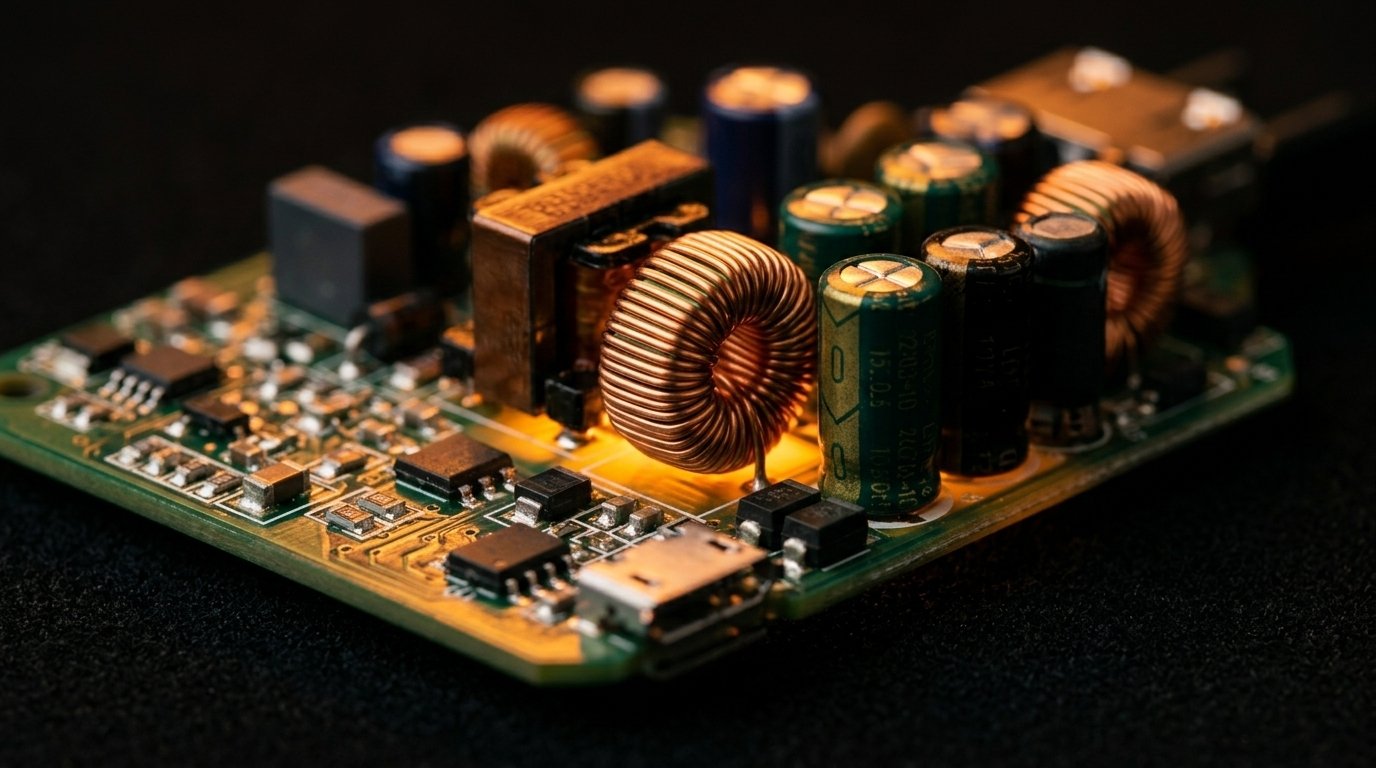
Certifications are the external signal. The internal components are where safety is actually built or cut. What we’ve observed in the market is that price-slashing almost always begins inside the unit — with cheaper capacitors, thinner transformers, or absent protection ICs.
1. The Transformer and Isolation Gap
Every AC-to-DC charger contains a transformer that steps voltage down from mains power. A safe charger maintains a sufficient physical isolation gap between the primary (mains) and secondary (low-voltage output) sides. Cheap chargers compress this gap to save space and cost, creating a risk of high-voltage arcing to the output side — and directly to your device or hands.
2. Capacitors and Voltage Smoothing
High-quality electrolytic capacitors rated to 105°C handle the heat of repeated charge cycles without degrading. Budget chargers use 85°C-rated capacitors that swell, leak, and fail — often spectacularly. This is one of the most common root causes of charger fires.
3. The Controller IC
The controller chip manages output voltage and current. Branded chargers from reputable manufacturers use controllers from established semiconductor companies (Texas Instruments, ON Semiconductor, etc.). Off-brand chargers often substitute unmarked or downgraded ICs with no fault detection capability.
4. Fusing and Thermal Cutoffs
A safe charger includes a fuse on the primary side and a thermal cutoff (TCO) component. If the transformer overheats, the TCO breaks the circuit. If there’s a surge, the fuse blows. Counterfeit chargers frequently omit both, meaning a failure has no failsafe.
Safe vs. Unsafe Charger: Side-by-Side Comparison
| Feature | Certified / Quality Charger | Counterfeit / Budget Charger |
|---|---|---|
| Third-party certification (UL, CE, MFi) | ✔ Present & verifiable | ✘ Printed logo only or absent |
| Isolation gap (primary to secondary) | ✔ ≥ 5.5mm (IEC standard) | ✘ Often < 1mm or bridged |
| Capacitor temperature rating | ✔ 105°C rated | ✘ 85°C or unrated |
| Over-voltage protection (OVP) | ✔ Hardware + firmware | ✘ Absent or software-only |
| Over-current protection (OCP) | ✔ Dedicated protection IC | ✘ Absent |
| Thermal cutoff (TCO) | ✔ Present | ✘ Absent |
| Primary-side fuse | ✔ Present | ✘ Often absent or bypassed |
| Short-circuit protection (SCP) | ✔ Active | ✘ Absent |
| Output ripple voltage | ✔ < 50mV (clean power) | ✘ 300–500mV+ (dirty power) |
| Strain relief on cable entry | ✔ Molded, robust | ✘ Thin, cracks quickly |
The Five Protection Circuits Every Safe Charger Must Have
Beyond components, safety is defined by the protection circuit stack. Think of these as the five lines of defense between mains voltage and your battery:
- Over-Voltage Protection (OVP) — Cuts output if voltage spikes above the safe limit for your device. Critical for preventing battery damage and thermal runaway.
- Over-Current Protection (OCP) — Limits current draw. Prevents cable overheating and shields devices from excessive amperage during fault conditions.
- Short-Circuit Protection (SCP) — Shuts the charger down immediately if the output is shorted. The absence of SCP is a direct fire risk.
- Over-Temperature Protection (OTP) — Monitors the charger’s internal temperature and throttles or cuts output before dangerous heat levels are reached.
- Over-Power Protection (OPP) — Caps total wattage output. Especially important in GaN chargers where high power density creates more heat per unit volume.
A charger missing any one of these is not “slightly less safe” — it’s operating without a critical failsafe. In my professional experience, the majority of charger-related device failures and fire incidents trace back to the absence of OVP or SCP specifically.
🔋 Recommended Resource
Not Sure Which Charger Is Actually Safe for Your Device?
Our weekly Power Accessories Digest breaks down certified chargers, cables, and power banks — vetted against the criteria in this article. No sponsored reviews, no affiliate padding. Just engineering-first analysis delivered to your inbox every Tuesday.Subscribe Free →
GaN Chargers: Safer by Design or New Risk Vector?
Gallium Nitride (GaN) chargers have largely replaced silicon-based designs at the premium end of the market. GaN semiconductors switch faster and generate significantly less heat than traditional silicon, which is a genuine safety advantage — but only in well-engineered implementations.
What we’ve observed in the market is a wave of low-cost GaN chargers that use the technology as a marketing badge without the engineering to back it up. A GaN charger without proper thermal management and a full protection circuit stack is not safer than a quality silicon charger — it’s just smaller.
When evaluating a GaN charger, apply the same certification and protection circuit checklist. The underlying semiconductor technology does not substitute for design integrity.
USB Power Delivery (USB-PD) and Safety
USB Power Delivery allows chargers to negotiate higher wattages dynamically — up to 240W under USB-PD 3.1. Safe USB-PD chargers use certified controllers (like Texas Instruments TPS65987) that handle the handshake protocol correctly. Fake USB-PD chargers often push maximum voltage regardless of what the device requests, which can damage or destroy the charging controller in your phone or laptop.
The Cable Is Half the Equation: What Makes a Charging Cable Safe
A certified charger paired with a counterfeit cable is still a compromised system. The cable must match the charger’s output capability in both current rating and build quality.
- Wire gauge — A USB-A cable rated at 2.4A must use 24AWG data wires and 28AWG power wires at minimum. Thinner wire = higher resistance = heat.
- E-Marker chip (USB-C) — USB-C cables carrying over 60W must contain an E-Marker IC that communicates the cable’s current rating to the charger. A cable without an E-Marker will not safely support 100W charging.
- Strain relief — The junction between the cable and the connector is the highest-stress point. Quality cables use reinforced, molded strain relief. Cheap cables crack here first, exposing live wires.
- Braided shielding — Not a marketing feature — it reduces electromagnetic interference and provides physical protection to the conductors inside.
How to Verify a Charger Is Actually Safe Before You Buy
Here is a practical, repeatable process for verifying charger safety — applicable whether you’re buying for yourself or procuring accessories at scale:
- Locate the certification mark — It should be molded or printed on the charger body, not just on the box. UL marks include a file number (e.g., “UL E12345”).
- Cross-reference the database — UL’s certification database is public at iq.ulprospector.com. Enter the UL file number and verify the manufacturer and product match exactly.
- Check the weight — Legitimate chargers with proper transformers and shielding have noticeable weight. A feather-light charger almost certainly lacks internal isolation and filtering components.
- Inspect the plug pins — On a US plug, the prongs should be firm, properly spaced, and not exhibit any wobble. Loose pins indicate poor mechanical assembly throughout.
- Check for regulatory text — A compliant charger lists input/output ratings, the manufacturer’s name, country of manufacture, and model number. Missing any of these is a red flag.
- Thermal test (advanced) — After a full charge cycle, the charger body should be warm but never uncomfortably hot to hold. Surface temperatures above 50°C (122°F) indicate inadequate thermal management.
Charger Safety by Brand Tier: What the Market Actually Looks Like
Not all reputable-sounding brands are equal. The market segments into roughly three tiers based on engineering investment:
Tier 1 — Original Equipment Manufacturers (OEM)
Apple, Samsung, Sony, and similar OEMs design chargers specifically for their device ecosystems. These carry the full suite of certifications and are engineered to precise voltage/current tolerances. They’re the safest option for the device they’re designed for, though often the most expensive.
Tier 2 — Certified Third-Party Manufacturers
Brands like Anker, Belkin, Aukey (post-2021 relaunch), and Ugreen invest in genuine certification and publish their protection circuit specifications. These are the best value proposition for most buyers — certified safety at lower price points than OEM.
Tier 3 — Uncertified / Marketplace Generics
These include most items sold under non-brand “pack of 3 for $7” listings on major marketplaces. They may carry printed certification logos but have not been independently tested. Avoid these for anything beyond the most disposable use case.
✅ Take Action
Upgrade to a Certified Charger — Shop Our Verified Picks
Every charger in our recommended list has been verified against the certification criteria and protection circuit checklist outlined in this article. No guesswork, no counterfeit risk.Browse Certified Chargers →
Frequently Asked Questions About Charger Safety
1. Is it safe to use a third-party charger for my iPhone?
Yes — provided the charger carries an Apple MFi certification and has been independently tested. MFi-certified third-party chargers from brands like Anker or Belkin are safe. Generic non-certified chargers bypass Apple’s voltage negotiation protocol and can damage your battery or charging port over time.
2. Can a cheap charger damage my phone battery?
Yes. An uncertified charger without over-voltage or over-current protection delivers inconsistent power that accelerates battery degradation. In worst cases, it can trigger thermal runaway in lithium-ion cells — the mechanism behind battery swelling and fires.
3. How can I tell if my charger is a fake or counterfeit?
Check the weight (real chargers are heavier), verify the certification number in the certifying body’s public database, and look for complete regulatory labeling (manufacturer name, model, input/output specs). If the charger runs very hot within 10 minutes of use, that’s also a strong indicator of counterfeit components.
4. Are GaN chargers safer than traditional chargers?
GaN chargers generate less heat due to their more efficient switching, which is a genuine safety benefit. However, a GaN charger is only as safe as its full circuit design. A poorly engineered GaN charger without proper protection circuits is not safer than a quality traditional charger — always verify certifications regardless of the semiconductor technology used.
5. Is it safe to leave a charger plugged in overnight?
A certified charger with over-temperature protection and a quality cable is generally safe to leave plugged in. Modern devices also stop drawing current once fully charged. The risk increases significantly with uncertified chargers, which lack the thermal cutoffs needed to handle extended operation safely.
6. What does the UL certification mark actually guarantee?
A genuine UL Listed mark means the charger was physically tested by Underwriters Laboratories to the relevant safety standard (UL 62368-1 for audio/video and IT equipment). It guarantees the product met the standard at time of testing — not that every unit off the production line is identical, which is why verifying the UL file number in the public database matters.
7. Can I use a higher-wattage charger than my device needs?
Yes, safely. Your device negotiates the amount of power it draws via the USB Power Delivery or proprietary charging protocol. A 65W charger connected to a phone that requests 18W will only deliver 18W. The charger’s wattage rating is a maximum output capacity, not a fixed delivery amount.
8. What is the most common cause of charger-related fires?
The most common causes are absent short-circuit protection combined with poor-quality capacitors. When a cheap capacitor fails, it can create a short circuit inside the charger. Without SCP, that fault has nowhere to go — and the resulting heat can ignite the plastic housing or nearby materials.
9. Are wireless chargers safer than wired chargers?
Neither is inherently safer — both depend on the same certification and protection circuit factors. Wireless chargers add a foreign object detection (FOD) layer, which prevents energy from being transferred to metal objects that could heat up. Certified Qi 2.0 wireless chargers are well-engineered; uncertified wireless chargers carry the same risks as uncertified wired ones.
10. How long should a quality charger last before it needs replacing?
A well-engineered charger using quality 105°C-rated capacitors should last 5–7 years under normal daily use. Signs that a charger needs replacement include intermittent charging, the charger running unusually hot, any smell of burning plastic, visible cable fraying near the connectors, or physical damage to the housing.